At Authentically Belize, we believe Belizean businesses, creatives, and entrepreneurs are part of the country’s living story. In Belize, trust often moves through word of mouth, WhatsApp messages, Facebook tags, recommendations, and direct relationships. But once someone becomes interested, the next step needs to be clear.
In this Partner Highlight, Sharday, founder of BzHub Connect, shares why being visible online is only part of the journey and why making it easy for customers to contact you can make the difference between missed attention and real opportunity.
🎧 Prefer to listen? Play the audio above.
We spend a lot of time thinking about how to get people to notice what we offer. We post on social media, create content, advertise, ask for referrals and try to get more eyes on our work. All of that matters, but there is another part of the customer journey that deserves just as much attention; what happens after someone becomes interested?
Recently, I had two experiences while trying to contact local Belizean creatives about potential collaborations. The circumstances were different, but both exposed the same problem. We can put considerable effort into being visible online without paying enough attention to how easy it is for someone to actually reach us once we have their attention.
In the first situation, I was trying to reach a local artist and influencer with an established presence across Facebook, Instagram and TikTok. I assumed that finding a direct way to contact her would be fairly simple, but after checking her different platforms, I could not find one. I eventually sent her a direct message on Instagram and waited. After a few days, she responded and provided a WhatsApp number where I could finally contact her.
It worked out in the end, but the experience made me consider what might have happened under different circumstances. What if I had been representing a company with a significant paid opportunity? What if someone wanted to hire her for a campaign, book her for an event or privately discuss a collaboration? Would everyone have spent several days searching and waiting for a response, or would some simply have moved on to someone who was easier to reach? A delay like this does not always feel like a lost opportunity because the person never sees what did not happen. The company that moved on does not always explain why. The customer who gave up does not always leave a comment. The person who wanted to collaborate does not always come back and say, “I was interested, but I could not find a way to reach you.”
That is what makes this problem easy to overlook. The missed opportunity is often invisible. From the outside, it may look like no one reached out, when in reality someone may have been interested enough to look, but not patient enough to search.
A second experience made the issue even more interesting because this person’s online presence initially appeared much more organized. Her Instagram profile had a Linktree, so naturally I clicked it expecting to find a straightforward way to connect with her. Instead, I was presented with somewhere around twelve or thirteen different links. There was plenty to explore, including a portfolio, but the basic information I was actually looking for, an email address or phone number, was not readily available.
I went through the portfolio hoping to find contact information there, but still found nothing. Eventually, I returned to her Instagram profile and noticed the Contact button. After opening it, I was able to find an email address. Her phone number was another matter. Rather than displaying it, Instagram presented an option to request the number, adding yet another step to what should have been a relatively simple process.
These two experiences highlighted different versions of the same problem. In one case, there was no obvious path to make direct contact. In the other, there were plenty of links and information, yet the most basic action I wanted to take was still unnecessarily difficult. It reminded me that having an online presence is not the same thing as having an effective customer journey.
Facebook, Instagram and TikTok are excellent tools for discovery. Someone can come across your work without ever having heard of you before. A friend can tag your page, a customer can share one of your posts, someone can recommend you in a WhatsApp conversation, or a video can reach thousands of people outside your existing audience. Social media has made it easier than ever for entrepreneurs and creatives to become visible, but visibility is only the beginning.
Once someone’s attention has been captured, there needs to be a clear next step. If they want to contact you, how many steps does it take? Can they immediately find a working WhatsApp number or email address? Can they find your location? If appointments are required, is there an obvious way to book? If they want to see more of your work, can they find your portfolio? If you have a website, is it clearly accessible?
This is also where information hierarchy becomes important. We sometimes assume that providing more options creates a better experience, but that is not always true. A page containing twelve different links may technically provide plenty of information, yet still leave a visitor struggling to find the one thing they actually came for. More information is only useful when it is organized in a way that makes sense to the person using it.
The goal should not simply be to collect every digital destination connected to your brand. The goal should be to understand why someone is visiting and make the most important actions easy to find. A customer does not usually arrive with unlimited patience. They may be looking for one specific thing: a WhatsApp number, a booking link, a menu, a price list, a portfolio, a location, or a way to ask a private question.
When every link is presented with the same level of importance, the visitor has to do the work of deciding what matters. That may not sound like a big issue, but online attention is fragile. Every extra step creates a chance for someone to pause, get distracted, or move on. If someone is ready to book, collaborate, inquire or spend money, the route to doing that should not be buried beneath everything else.
There is also a privacy consideration that is easy to overlook. We sometimes see people commenting publicly under posts asking someone to check their messages because they have been unable to reach them privately. Not everyone wants to do that. Someone may be reaching out about a professional opportunity, a private service, a financial matter or a collaboration they do not want announced publicly. A clear contact path gives people the ability to reach out without having to publicly draw attention to themselves first.
This conversation is particularly relevant in Belize because so much of our commerce still moves through relationships, recommendations and direct communication. We ask friends for the number of a good mechanic. Someone recommends the person who did their nails. A cousin sends us the name of a photographer. A customer forwards a DJ’s information through WhatsApp. Someone tags a caterer on Facebook. A visitor asks a local for a tour operator they trust.
Word of mouth remains incredibly powerful, but the way we act on those recommendations has changed. Today, the recommendation may only give someone a name, a handle, or a tag. The potential customer still has to complete the journey on their own.
That means the online presence has become part of the trust process. People are not only asking, “Is this person good?” They are also asking, “Can I understand what they offer? Can I see their work? Can I contact them easily? Do they look active? Do they feel professional enough for me to take the next step?”
Facebook, Instagram, TikTok, WhatsApp, Google, a booking platform, a portfolio or a website. That creates more opportunities for entrepreneurs to be discovered, but it can also scatter important information across several different places.
Consider the difference between someone recommending a hairstylist by saying, “Search her name on Instagram. I think her number is somewhere on there,” and simply saying, “Here is her link. Everything you need is there.” The recommendation has not changed, and neither has the quality of the hairstylist’s work. What has changed is the amount of effort required for the potential customer to act on that recommendation.
That matters because customer interest is not unlimited. Someone who is actively searching for a service today may not still be searching tomorrow. They may encounter another provider whose information is clearer, whose contact details are immediately available or whose booking process requires fewer steps. Sometimes the person who gets the inquiry is not necessarily the person with the largest following. It may simply be the person who made the next step easier.
One of the most useful things an entrepreneur can do is audit their online presence from the perspective of someone who knows absolutely nothing about them. Open your Facebook page, look at your Instagram profile, click the link in your bio and search your name or brand on Google. Then try to forget everything you already know about your own setup.
Ask yourself whether a first-time visitor can quickly understand what you offer and how to contact you. If you operate from a physical location, can they find it? If you take appointments, is the booking process obvious? Can they easily see examples of your work? If you have a website, portfolio, menu or other important resource, is it easy to find? If you have several links, are the most useful ones given priority, or does everything compete equally for attention?
Most importantly, ask yourself what would happen if someone became interested in what you offer right now. Would that person know exactly what to do next?
If the answer to several of those questions is no, you may not have a visibility problem at all. You may have a customer journey problem. That distinction is important because spending more money on advertising, producing more content or chasing more followers will not necessarily fix what happens after people arrive. Attracting more people into a confusing experience simply gives more people the opportunity to experience the same friction.
This does not mean every entrepreneur needs an elaborate website. Websites are valuable and, for many growing brands, become an important part of their digital infrastructure. They can improve search visibility, provide detailed information, generate leads, support e-commerce and perform functions that a simpler online presence cannot. But businesses and entrepreneurs are at different stages, and their digital needs are not identical.
Some need a full website. Some already have one. Others simply need a professional way to organize the pieces of their existing online presence. Even businesses with websites can benefit from making the route to that website, their WhatsApp, booking system, portfolio or other important destinations easier to navigate. The objective is not to use a particular piece of technology simply because it exists. The objective is to reduce unnecessary friction between interest and action.
These experiences also reinforced one of the reasons I created BzHub Connect. I kept noticing that entrepreneurs often already have the information people need, but that information may be scattered across different platforms or presented without enough consideration for what the visitor is most likely trying to accomplish.
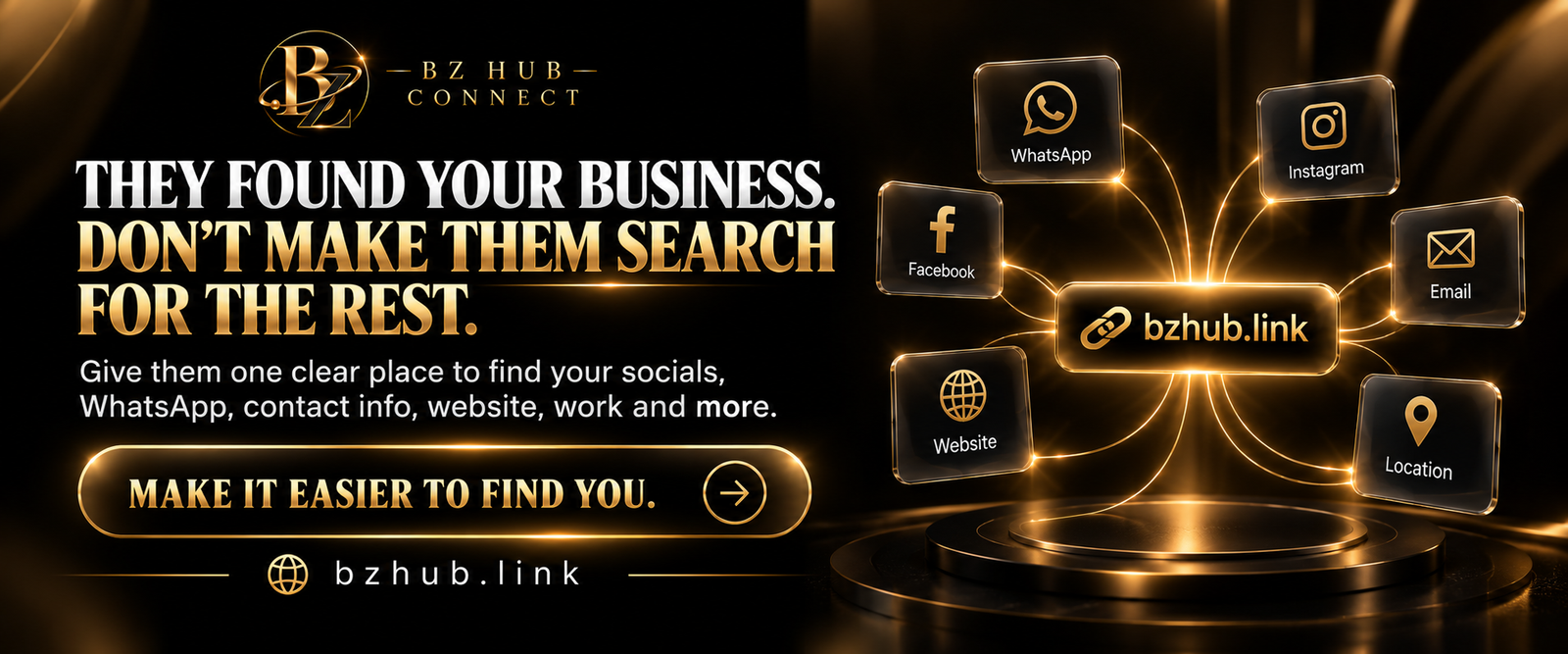
BzHub Connect was created as a personalized way to bring those important customer touchpoints together through one professional link. The intention is not simply to collect as many links as possible. It is to organize the important parts of an online presence around the individual brand and how people need to interact with it. Each BzHub can reflect the look and identity of the person or brand it represents while creating a clearer path to relevant information and destinations.
It is also not intended to compete with or replace a full website. If someone already has a website, that website can be part of their BzHub and made easier to access alongside other important destinations. If someone is not yet at the stage where a full website makes sense, a BzHub can provide a more organized and professional starting point.
The larger principle, however, applies regardless of whether someone uses BzHub, a website or another digital solution. Once a person has shown interest in what you offer, you should make it as easy as reasonably possible for them to continue. That is the space BzHub Connect was created to serve. Not by replacing social media. Not by replacing a full website. But by helping entrepreneurs, creatives, service providers, and small brands organize the most important parts of their online presence into a clearer path.
There will always be another social media platform, another marketing trend and another strategy promising greater visibility. Visibility matters, and so do reach, content and promotion. But before investing more time and money into getting additional people to discover you, it is worth examining what happens to the people who are already interested.
Search for yourself. Visit your own social media profiles as though you were a stranger. Click your own links. Try to find your contact information without relying on anything you know simply because it belongs to you. Pay attention to how many steps it takes to accomplish the most obvious actions.
You may discover that the issue is not a lack of information. You may even discover, as I did in my second experience, that there is plenty of information. The real question is whether the right information is easy to find at the right moment.
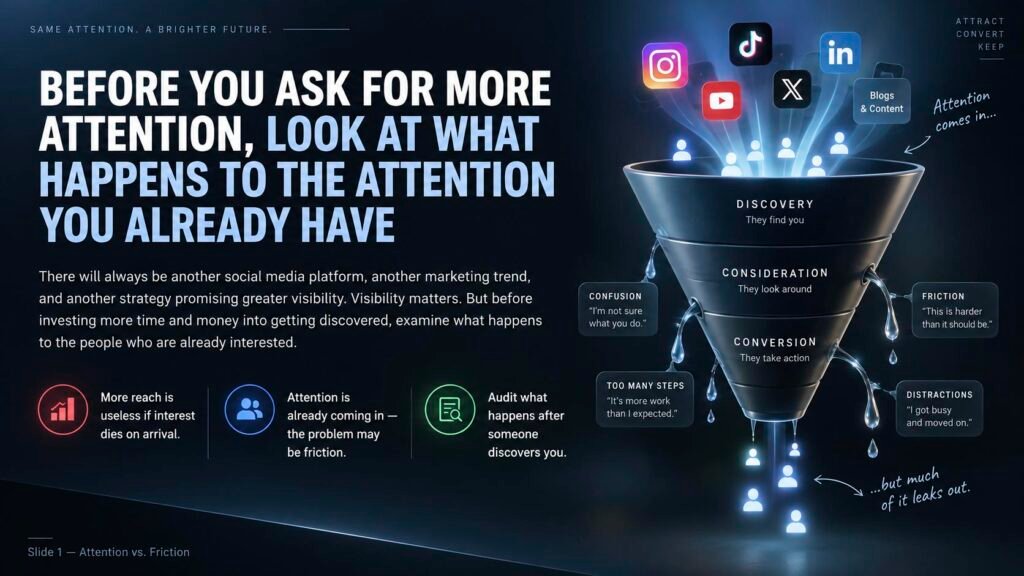
Sometimes the opportunity is already there. The person has already heard about you, found you and decided they are interested. At that point, the most important thing your digital presence can do is make sure they do not have to work unnecessarily hard to reach you.
BzHub Connect is a personalized professional link that brings the most important parts of your online presence together in one clear place. It helps customers quickly find the information they need and take the next step.
No. BzHub Connect is not designed to replace a full website. If you already have a website, it can become one of the important destinations inside your BzHub. If you do not need a full website yet, a BzHub can give you a more organized and professional starting point.
BzHub Connect is designed for entrepreneurs, creatives, service providers and small brands that want to make their online presence easier for customers to navigate.
Yes. Social media helps people discover you, while your BzHub gives them a clearer path after they become interested. It can help connect your different platforms and important information instead of leaving customers to search for them individually.
It helps solve the gap between being visible online and being easy to reach. Someone may already know about your business and be ready to contact, book or buy from you. BzHub Connect helps make sure the next step is clear.
BzHub Connect helps Belizean entrepreneurs, creatives, service providers, and small brands organize their important links and customer touchpoints into one professional, personalized link.